T City
The Box ManT City is the setting where the box man turns urban survival into a practical art, and where a report of a boxed corpse on the outskirts becomes entangled with a concealed death. The city appears not as a mapped panorama but as a field of crowds, food sources, routines, and risks, measured from the restricted viewpoint of life beneath cardboard.
Setting and Urban Life
For the box man, the city is a place that must be learned through repeated movement. His initial self-consciousness and diffidence toward other people last only two or three months; outward appearance eventually matters less than the daily needs that continue regardless of his chosen condition. He must eat, sleep, and relieve himself, and when his stored food runs out he has to go into busier areas where there is greater variety and abundance.
This practical geography shapes how the city is experienced. The box man can obtain food from store counters, but foraging among leftovers also gives him a way to become accustomed to town and to live among its crowds. The difficulty is not simply finding something edible: mixed smells make discarded food hard to accept, and over three years the stench remains something he cannot get used to. His urban knowledge is therefore bodily and selective, formed by the difference between what can be obtained and what can be endured.
The City as a Worked Environment
The box man’s life depends on adapting ordinary objects to the limits of his mobile shelter. He keeps personal effects to a minimum, hanging essentials such as a radio, mug, thermos, flashlight, towel, and small bag from wire hooks. Rubber boots must have no holes, while canvas wrapped around the waist helps hold the box in place and leaves room for movement and bodily necessities. These details make the city legible through maintenance: survival depends on keeping the shelter usable while moving through public space.
A milky-white plastic board, sixteen by eighteen inches, demonstrates how much function can be packed into a single possession. It serves as a table for eating and card fortune-telling, a chopping board, a rain shutter for the observation window, a fan, a portable bench, and a work surface for preparing collected cigarette butts. The box man recalls that he once accumulated useless objects under the ordinary assumption that they might come in handy; life on the move instead requires selecting what can genuinely serve more than one purpose.
The city also alters the box man’s sense of time. Once he has become used to its streets and crowds, time seems to form concentric circles around him: the background rushes past, the foreground slows, and the center becomes still. This stillness is not caused by an absence of urban motion but by the contrast between the moving city and the box man’s fixed point of observation.
The Boxed Corpse on the Outskirts
A retrospective account places an unidentified body on the outskirts of a little-frequented seaside park in T City. The corpse wears a packing-cardboard box over its head, secured by a cord around the waist, and has no possessions apart from the box. The initial explanation is that the dead man was a box man who accidentally fell into a canal and was carried by the tides to the beach. An autopsy places the presumed time of death about thirty hours before the body was found.
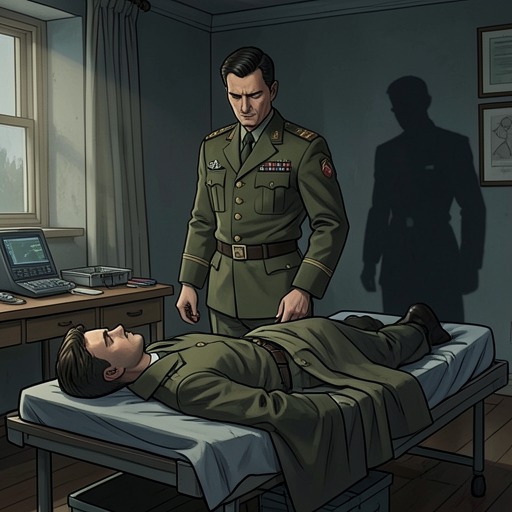
That account is not the last word on the corpse’s identity. In an unfinished affidavit, the narrator states that the body is actually the Army Medical Captain whose names he had borrowed in order to practice medicine. He says the captain had been at risk of suicide for some time and expresses regret that he failed to stop him. The shift from an apparently anonymous urban death to the death of a specific man changes the meaning of the seaside discovery and exposes how an official-sounding explanation can conceal a personal history.
Narrative Significance
T City joins two scales of experience: the repeated, material work of getting through each day and the singular discovery of a body that unsettles the story’s chronology. The corpse report is drafted in advance of the events it describes, while the later affidavit offers a different identification and context. The city’s outskirts thus become a point where the box man’s habitual world of movement and observation meets a death whose explanation is still being constructed.
The setting’s significance lies in this tension rather than in a detailed portrait of its institutions or landmarks. T City offers crowded areas for obtaining food and a neglected edge where a boxed body can wash ashore; between them, the box man learns to treat streets, objects, and time as parts of a survival system. The same city that enables an improvised daily existence also supplies the landscape for a narrative in which appearances, identities, and the sequence of events remain uncertain.